Showing posts with label Porous metals. Show all posts

Wednesday, 1 July 2015

Metal Foam (closed cell) & (open cell)


Metal foam is a cellular structure made up of a solid metal containing a large volume fraction of
gas-filled pores. These pores can either be sealed (closed-cell foam), or they can be an interconnected network (open-cell foam). The closed-cell foam is referred to as metal foams, while the open-cell foam is referred to simply as porous metal.

Metals that Can Be Used
The metal that is commonly used to make metal foams is aluminium. However, other  varieties of metals can be used to make the foam, such as titanium and tantalum.

Properties of Metal Foam
The key properties of metal foam are as follows:
  • Ultralight material (75–95% of the volume consists of void spaces)
  • Very high porosity
  • High compression strengths combined with good energy absorption characteristics
  • Thermal conductivity is low
  • High strength
Applications
The main applications of metal foams and porous metals are listed below:
  • The closed variety is used for structural applications requiring load-bearing features, and for weight-saving and impact-absorbing structures in vehicles
  • The open variety is ideal for vibration and sound absorption, filtration and catalysis at high temperatures, for heat exchange and in medical devices.
  • The open variety is also useful in functional applications such as filtration and damping.
  • Foam metal is being used as an experimental prosthetic in animals.
  • Metal foams with high strengths can act as high-capacity impact-energy absorbers.
  • Automotive industry - the foams reduce the number of parts in the car frame, facilitate assembly, thereby reducing costs and improving performance.
From:  http://www.azom.com/article.aspx?ArticleID=8097#3 

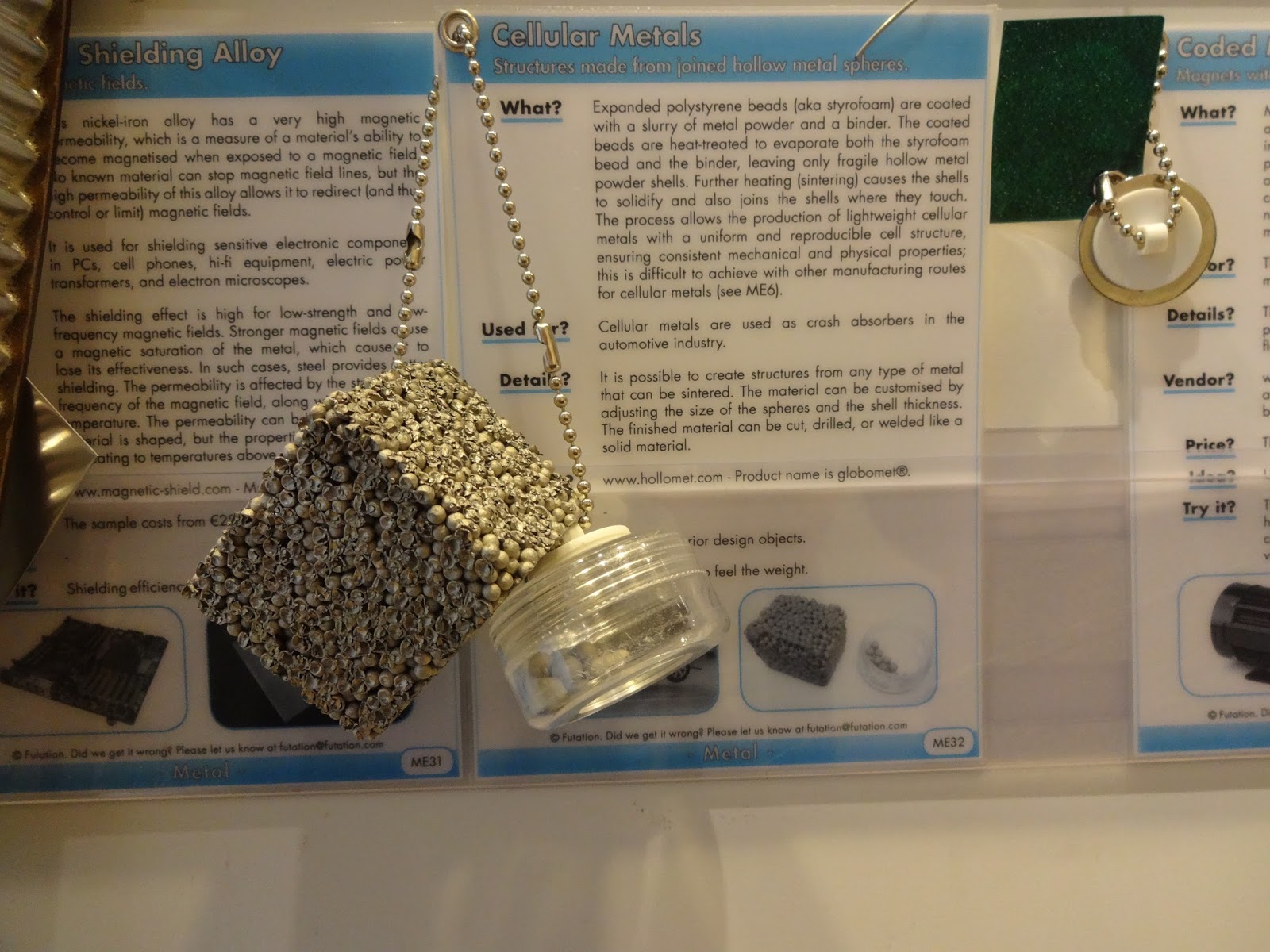
Closed Cell

Closed Cell


Cellular metals and metal foams


The possibilities for manufacturing metal foams or other porous metallic structures are reviewed. The various manufacturing processes are classified according to the state of matter in which the metal is processed — solid, liquid, gaseous or ionised. Liquid metal can be foamed directly by injecting gas or gas-releasing blowing agents, or by producing supersaturated metal–gas solutions. Indirect methods include investment casting, the use of space-holding filler materials or melting of powder compacts which contain a blowing agent. If inert gas is entrapped in powder compacts, a subsequent heat treatment can produce cellular metals even in the solid state. The same holds for various sintering methods, metal powder slurry foaming, or extrusion and sintering of polymer/powder mixtures. Finally, electro-deposition or metal vapour deposition also allow for the production of highly porous metallic structures. The various ways for characterising the properties of cellular metals are reviewed in second section of this paper. Non-destructive as well as destructive methods are described. Finally, the various application fields for cellular metals are discussed. They are divided into structural and functional applications and are treated according to their relevance for the different industrial sectors.

http://www.sciencedirect.com/science/article/pii/S0079642500000025